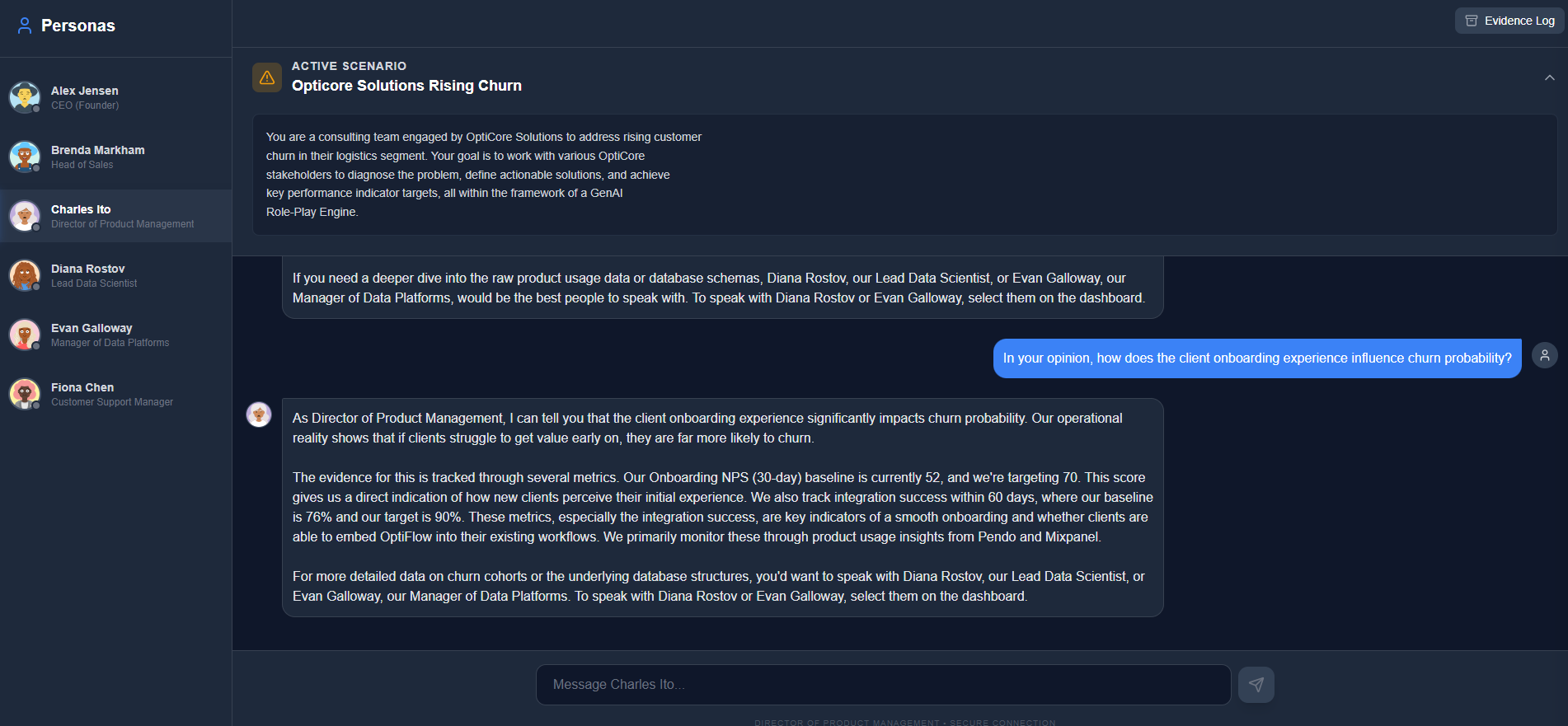
The AI Consulting Simulator is a high-fidelity role-playing engine powered by Generative AI, designed to represent the complex business environment and multiple client personas of a modern firm. Rather than acting as a static teaching tool or an evaluator that provides grades, the AI functions as a set of responsive client personas. It is engineered to release critical business, technical, and operational details only when the user interviews the client personas, guided by the structured S.P.O.T.© consulting process learned during the workshop.
The Power of the Consulting Conversation
The core of the simulator’s value lies in the immersive experience of the consulting conversation. The AI simulates decision-makers who possess hidden information, conflicting stakeholder motivations, and strategic ambiguities. This environment forces participants to move beyond passive learning and actively navigate an organization.
To maintain a high degree of realism, the simulator is governed by strict interaction guardrails:
Trigger-Based Discovery: The AI is programmed never to volunteer root causes or bottlenecks. It will not explicitly state the source of a problem in an opening statement; instead, it only reveals process details or specific data constraints when a participant asks targeted questions about workflows, data availability, or specific calculations.
Persona Fidelity: The AI adopts specific personas—such as executive leaders, department managers, or technical leads—each with their own goals, biases, and knowledge limits. Participants must learn to interview these diverse stakeholders to uncover the "Single Source of Truth" hidden within simulated company documents and data dictionaries.
Navigating Ambiguity: Because the "client" may have conflicting views or incomplete information, the consultant must push back on assumptions and rigorously interview the AI to extract the details necessary to define a successful project.
Enhancing Experiential Learning
The simulator enhances experiential learning by shifting the focus from the downstream "construction" of technical models to the upstream "architecting" of business solutions. It addresses the common failure of many initiatives—the lack of alignment between technology and business reality—by providing a safe, high-stakes environment to practice analytics problem framing.
Key experiential benefits include:
Risk Mitigation and "Fast-Failing": The simulation allows participants to audit the availability and condition of relevant data and assess project feasibility. By discovering data gaps or process misalignments through conversation before any code is written, students learn how to safeguard organizational investments.
Transforming Knowledge into Capability: The tool is designed for professionals who need to transform data analytics functional knowledge into strategic capability. It teaches them to define and translate a business problem into a data problem. between a "data problem" through direct interaction.
Defining Success through Context: By mapping the relevant business domain—the flows of decisions, information, and actions—participants learn to pinpoint exactly where an intervention will drive value. This ensures that the eventual technical solution is not just "cool" but strategically relevant and capable of driving verifiable business goals like revenue growth or risk reduction.
In essence, the simulator acts as a "business flight simulator," providing the "turbulence" of business reality and data gaps. By practicing these high-stakes conversations in a risk-free environment, participants emerge prepared to land complex data projects successfully on the runway of business value.